

Let’s skip the preamble; you’ve either heard about CDCP or already have it, and now you want to know whether it covers braces and orthodontics. The short answer is: “No, these services are not yet implemented, and when they do become available, they will come with specific conditions.” If you’re concerned about the CDCP braces coverage in Canada, this article is written exactly for you. So keep reading.
Does CDCP in Canada Cover Braces and Orthodontics?
At present, CDCP braces coverage does not generally cover most orthodontic services. On the official CDCP coverage page, orthodontic services are listed as “not currently available,” and only a limited range of such services may become requestable in the future, at a date that has not yet been determined. Even for those limited services, prior approval will be required.
You may also want to know: “Does CDCP Cover Wisdom Tooth Removal?”
What Exactly Does CDCP Say About Orthodontics?
According to the official benefits guide effective April 1, 2026, CDCP Dental Coverage includes only a “limited range” of orthodontic services for eligible individuals, and even those are not yet practically available, as their start date is still unspecified. The same guide emphasizes that once CDCP braces coverage services become available, preauthorization will be mandatory.
The Government of Canada itself states that CDCP’s preauthorization criteria are stricter than those of private insurance plans, and not all applications will be approved. Therefore, you should not assume that any orthodontic treatment recommended by a dentist will automatically be covered under this program.
Need Help Understanding Your CDCP Coverage Options?
At Walk In Family Dentistry, our team in North York is here to guide you through your options and help you make the right decision for your smile. Contact us to get personalized dental advice.
Who May Qualify for CDCP Braces Coverage?
Based on official CDCP guidelines, if CDCP orthodontic coverage becomes active, strict medical criteria will apply. In particular, only two groups may qualify:
1. Children under 18 with severe malocclusion

The child must have a “severe and primarily disabling” misalignment of the teeth, assessed using the modified Handicapping Labio-Lingual Deviation (HLD) Index. In simple terms, if the bite problem, such as a very deep overbite or underbite, or needs severe crossbite treatment, or significant irregularity is serious enough to impair normal oral function, it may meet the criteria.
2. Adults aged 18 and over
CDCP braces coverage applies only if a serious congenital jaw condition, such as a cleft lip and palate, has caused severe malocclusion. In other words, typical adults without genetic or severe conditions will not be covered.
This means that the vast majority of orthodontic patients, for example, those with moderate issues like crowded teeth, crooked teeth, mild spacing, or a standard overbite, will be completely excluded from CDCP coverage. The federal CDCP program is not designed to cover routine or cosmetic orthodontic treatments.
Types of Orthodontic Services and Their Coverage Under CDCP

In practice, orthodontic care can be divided into several categories, with coverage under CDCP as follows:
| Category | CDCP Coverage | Other Coverage | Patient Cost |
| Preventive (Children) | Not covered alone | Rare / partial (private) | 20–50% |
| Interceptive (Children) | Severe cases only + preauth | 50–80% (private) | 20–50% |
| Braces (Children) | Severe cases only + preauth | 50–80% (private) | 20–50% |
| Jaw Surgery (Children) | Limited cases | Partial (varies) | High / variable |
| Braces (Adults) | Only congenital cases | Very limited | Mostly out-of-pocket |
| Jaw Surgery (Adults) | Limited cases | Partial (private) | High / variable |
Explore the benefits of clear aligners instead of orthodontics and see if they’re right for you.
Step-by-Step Guide to Getting Braces Under CDCP
If you are considering orthodontic treatment, this guide can help you understand how much you may benefit from CDCP coverage.
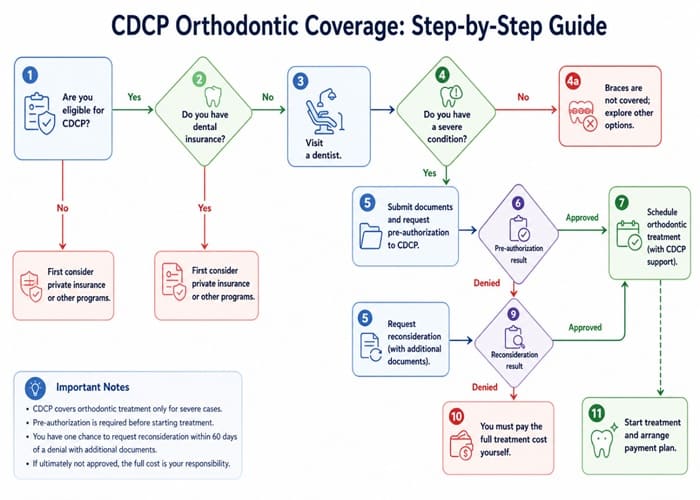
Note: Yes or no arrows indicate the decision path. If CDCP criteria are not met, refer to private or charitable options.
Learn more about: “Best Dental Insurances in Canada”
Conclusion and Next Steps
In summary, CDCP currently does not cover orthodontics, and for braces or Invisalign, you should rely on options such as private insurance, out-of-pocket payment, or financial assistance. If you are eligible for CDCP and have a very severe condition, you can try your chances by requesting preauthorization, but approvals are limited.
Still unsure about your eligibility for CDCP braces coverage or next steps? Visit Walk-In Family Dental at CDCP Dentist in North York to learn more about CDCP coverage and get personalized guidance.
FAQ
Does CDCP cover braces or Invisalign?
No. In its current state, orthodontics is not covered under CDCP. Only in the future, and for very specific cases involving severe dental issues, might partial coverage be available.
What exactly does CDCP preauthorization do?
Before treatment begins, it evaluates whether your medical condition meets the criteria for coverage, and without it, you should not expect reimbursement.
Do children have a better chance of receiving orthodontic coverage?
Yes, if they have a severe condition and a high HLD score, the likelihood of review and approval is higher.
How can I reduce additional costs?
Use all available financial supports, such as HSAs and government assistance. If you have a young child, charitable programs like Smiles4Canada may help. Include orthodontic costs in your tax return as a medical expense, as the tax authority may reimburse a portion.
What should I do if my request is denied?
If preauthorization is denied, you can only appeal once within 60 days of the denial. In the appeal, include new clinical documentation or additional explanations.
