When you visit a dentist, you may hear them calling out numbers like “tooth 16” or using strange terms such as “FDI notation.” To most patients, this sounds confusing, but to dentists, it’s a universal language for identifying and recording teeth. Tooth numbering and naming systems help dental professionals quickly communicate which tooth needs treatment.
In this blog, we’ll explain teeth numbers, names, and types, and show you how dentists use them for accurate identification. By the end, you’ll be able to understand what your dentist means when they mention certain tooth numbers or names. First, let’s learn about tooth numbering systems.

Everything About Tooth Numbering Systems
Dentists use tooth numbering systems to ensure accuracy when diagnosing, charting, and treating patients. There isn’t just one system; different countries and dental schools may use different methods. The three most common systems are:
- Universal Numbering System (used mainly in the U.S.)
- FDI Tooth Numbering System (popular internationally, especially in Europe)
- Palmer Notation Method (commonly used in orthodontics and oral surgery)
Let’s explore each one.
Universal Numbering System
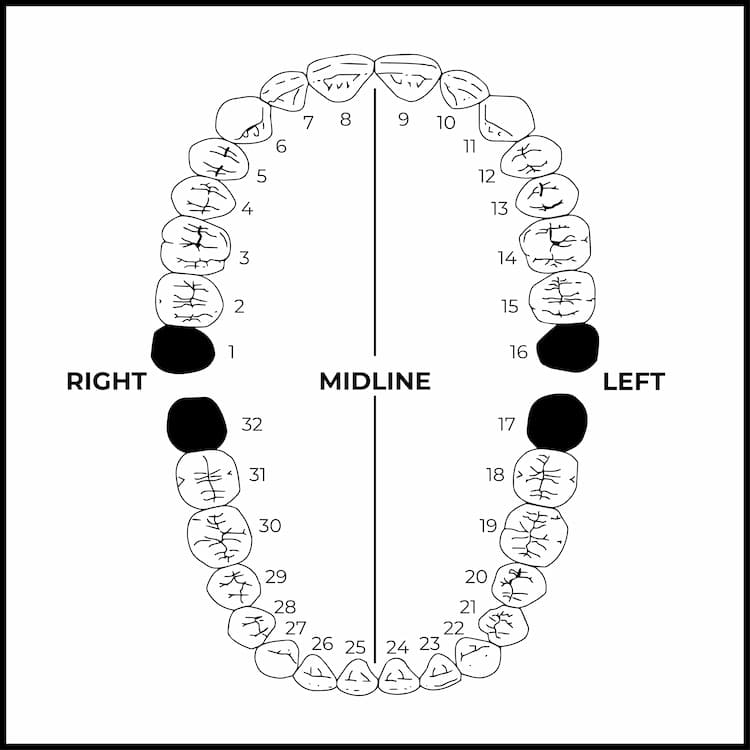
This is the standard in the United States. It assigns numbers to all 32 permanent teeth. Counting starts with the upper right third molar (wisdom tooth), which is tooth #1, and it moves along the upper teeth to the left, ending with the upper left third molar (#16). Then it continues on the bottom left third molar (#17), and goes across to the bottom right third molar (#32).
For example, if your dentist says “Tooth #8 has a cavity,” they are referring to your upper front right central incisor; the one that shows when you smile.
This system is straightforward and makes it easy to quickly identify teeth during treatment notes or dental reports. Here’s a simplified chart for permanent teeth:
| Quadrant | Tooth Range | Example |
| Upper Right | 1 – 8 | #1 is wisdom tooth, #8 is central incisor |
| Upper Left | 9 – 16 | #9 is central incisor, #16 is wisdom tooth |
| Lower Left | 17 – 24 | #17 is wisdom tooth, #24 is central incisor |
| Lower Right | 25 – 32 | #25 is central incisor, #32 is wisdom tooth |
FDI Tooth Numbering System
The FDI system, also known as the International Standard (ISO 3950), is widely used around the world. Instead of using a single continuous count, it breaks the mouth into four quadrants and uses a two-digit code for each tooth.
The first digit represents the quadrant:
- 1 = Upper right
- 2 = Upper left
- 3 = Lower left
- 4 = Lower right
The second one represents the tooth position from the midline (1 – 8). For example, tooth 11 is the upper right central incisor, tooth 24 represents the upper left first premolar, or tooth 38 is the lower left wisdom tooth.
| Quadrant | First Digit | Teeth Numbers (from midline to back) | Example Teeth & Their Meaning |
|---|---|---|---|
| Upper Right | 1 | 11–18 | 11 = central incisor, 18 = wisdom tooth |
| Upper Left | 2 | 21–28 | 22 = lateral incisor, 25 = second premolar |
| Lower Left | 3 | 31–38 | 33 = canine, 36 = first molar |
| Lower Right | 4 | 41–48 | 42 = lateral incisor, 48 = wisdom tooth |
Palmer Notation Method
The Palmer method is especially common in orthodontics. It uses symbols to indicate quadrants (┘└ ┐┌) combined with numbers or letters. In this method, permanent teeth are numbered 1 – 8 in each quadrant, starting from the midline outward. Also, primary (baby) teeth are labeled with letters A-E in each quadrant.
For example, an upper right central incisor is written as ┘1, and a lower left primary canine would be └C.
Read more: Demystifying Dental X-rays
Contact Us for Dental Care!
Need expert care for your teeth? At Walk In Family Dentistry, we provide complete dental checkups, restorative treatments, and cosmetic solutions. Book your appointment today and keep your smile healthy and bright!
Tooth Names and Types
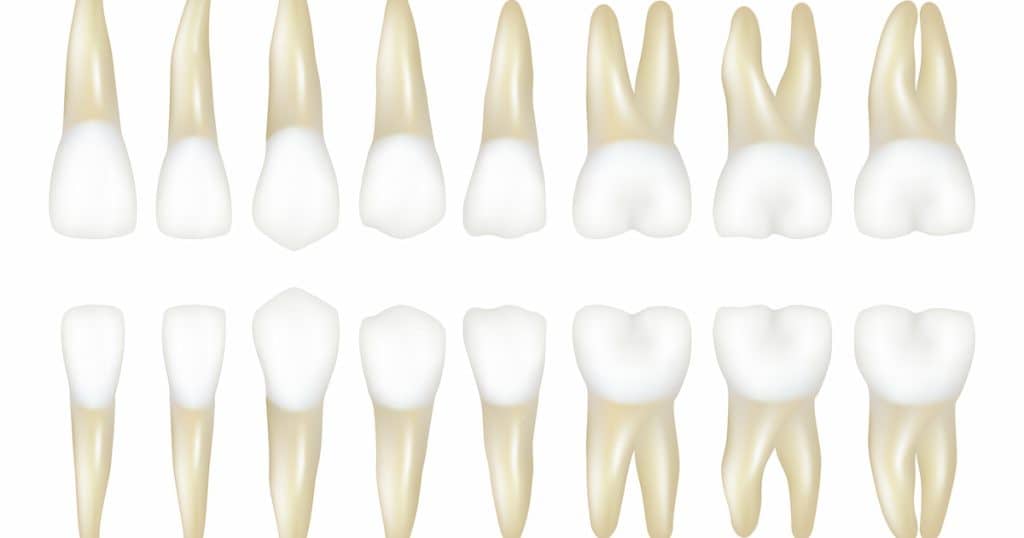
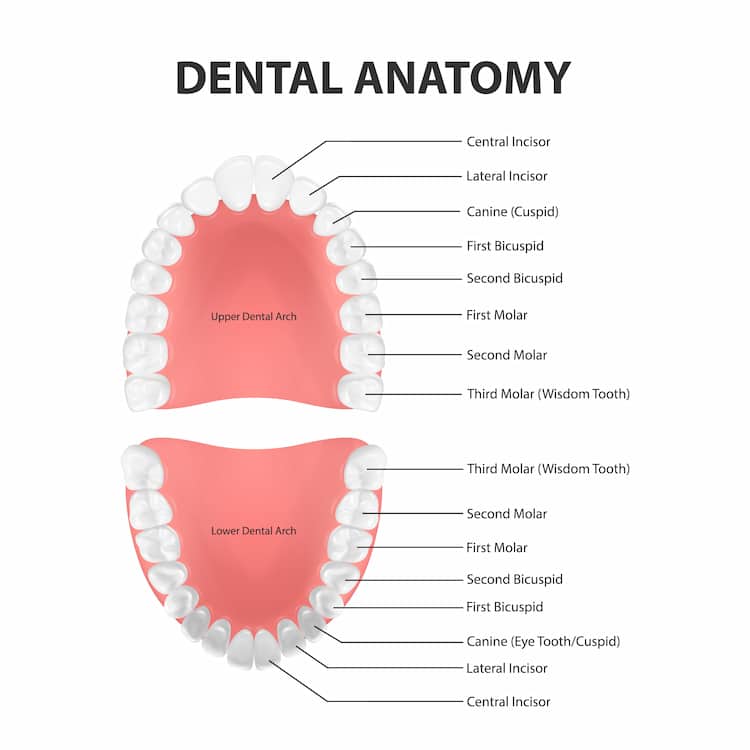
In addition to numbers, teeth also have names based on their type and function. Understanding these helps you know exactly what role each tooth plays in your mouth.
Permanent Teeth
Adults normally have 32 permanent teeth (including wisdom teeth), which erupt after the primary teeth fall out. These teeth are designed to last a lifetime and are divided equally among four quadrants. So, there are 16 teeth in the upper jaw (maxillary), and 16 in the lower jaw (mandibular).
Primary Teeth
Children have 20 primary teeth, also known as baby teeth or deciduous teeth. They usually begin erupting around 6 months of age and fall out between ages 6 – 12. Primary teeth are essential because they guide permanent teeth into their correct positions. Dentists often use letters A – T to refer to baby teeth in charts.
Tooth Types: Incisors, Canines, Premolars, Molars
Each tooth type has a unique function. Let’s check their names and what they do.
- Incisors: The four front teeth in each jaw (8 total). They are sharp and used for cutting food.
- Canines: Pointed teeth next to the incisors (4 total). They help tear food.
- Premolars (Bicuspids): Located behind the canines (8 total) with flat surfaces for crushing and tearing.
- Molars: Larger teeth at the back (12 total, including wisdom teeth), responsible for grinding food.
Read more: Why a Dental Checkup is Important?
How Dentists Use Tooth Charts for Identification
Tooth charts are essential tools in modern dentistry. Dentists rely on them to accurately record the condition of each tooth during checkups and treatments. For example, when diagnosing a cavity, a dentist can mark its exact location on the chart, ensuring clear documentation for future visits. In pediatric dentistry, tooth charts are especially useful for tracking the eruption and shedding of primary teeth, helping parents and dentists know whether a child’s development is on schedule.
Orthodontists also depend on these charts to map out tooth positions and design braces or aligners that guide teeth into the right place. Even in cases involving wisdom teeth, charts allow dentists to monitor their growth and determine whether extraction is necessary.
Beyond individual care, tooth charts are valuable for communication between dental professionals. If a patient moves or needs specialized treatment, charts provide a universal reference that ensures consistency and avoids mistakes. In short, tooth charts serve as a shared language in dentistry, giving patients more accurate diagnoses and better treatment plans.
Read more: What Are the Benefits of Visiting a Dentist?
Conclusion
Tooth numbering and naming systems may seem complicated at first, but they play a vital role in dentistry. The Universal Numbering System, FDI System, and Palmer Notation Method all help dentists clearly identify and treat teeth. Combined with tooth names like incisors, canines, premolars, and molars, these systems create a universal dental language.
At Walk In Family Dentistry, we believe patients should feel confident about their oral health. The next time your dentist calls out tooth numbers, you’ll know exactly what they mean! So, why not schedule your visit with Walk In Family Dentistry today and get in touch with your dentist in North York?
FAQ
What are the tooth numbers 1, 16, 17, and 32?
In the Universal Numbering System, tooth #1 is the upper right wisdom tooth, tooth #16 is the upper left wisdom tooth, tooth #17 is the lower left wisdom tooth, and tooth #32 is the lower right wisdom tooth.
What does 1/2 3/4 mean at the dentist?
These are shorthand notations dentists use to describe tooth surfaces. For example, a dentist might say “1/2” to indicate half of the tooth’s surface or “3/4 crown” to mean a restoration covering three-fourths of the tooth.
What are the normal teeth for a smile?
When you smile, the most visible teeth are the upper front teeth; your central incisors, lateral incisors, and sometimes canines and premolars. A “full smile” usually shows 8 – 10 teeth.
What are the numbers dentists say when looking at your teeth?
Dentists call out tooth numbers to the assistant to record notes. For example, they might say “Tooth #14 has a cavity,” which means the upper left first molar.
Now that you understand how teeth are numbered and named, we’d love to hear from you; did this guide make dental visits less confusing for you? Drop your thoughts or questions in the comments below!